It is easy to come across PET bottles in everyday life. Have you ever wondered how a PET bottle is formed? What is the blowing process of PET bottles? Let’s explore the process in this article with FGC.
Introduction
PET bottles are among the most popular containers in various industries thanks to their convenience, lightweight, durability, and flexibility. Food, beverages, household, cleaning, and personal care products are commonly packaged in PET bottles. PET plastic has many special qualities that make it perfect for food and liquid containers.
What is PET?
PET, short for polyethylene terephthalate, belongs to the polyester family of polymers. It is the most commonly used resin of this family, which can be seen in fibers for clothing, food and beverage packaging, and thermoforming for production. Synthetic fibers comprise a large portion of PET manufacturing, with bottles covering around one-third of global demand. PET’s materials can be heated to a molten state, making it possible to mold or extrude the plastic into any shapes and sizes. The temperature range that this plastic can withstand is -40°C to 150°C.
PET is renowned for superb characteristics, including heat, chemical, mechanical resistance, and dimensional stability. Generally, PET is transparent, durable, and versatile, and when stable, it takes the form of semi-crystalline. It also has excellent gas and moisture barrier properties. Besides, it is lightweight and shatter-resistant, so it does not break or fracture, making it easy and efficient to transport. It is accepted to be safe when in contact with food and drinks by many prestigious organizations in the world.
Another outstanding feature of PET is its recycling ability. PET packaging may be composed entirely of recycled plastic and then recycled again. It can be thoroughly cleaned and remelted, or else it can be chemically broken down to create new PET resin pellets, which can then be reproduced.
The two main types of PET are vPET and rPET. vPET, also called virgin PET, is a high-purity plastic resin, which is made from unprocessed petrochemical materials, such as natural gas and crude oil. It is usually applied in food and beverage packaging, where quality and clarity are crucial factors. Meanwhile, rPET, or recycled PET, is produced from used plastic waste that is cleaned, reprocessed, and reused as new PET resin.
Which products are PET bottles suitable for?
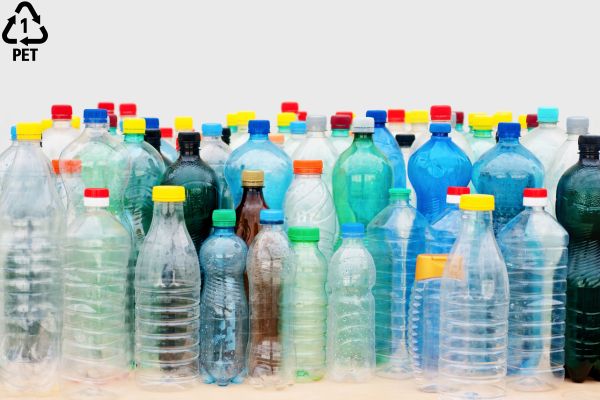
PET is very adaptable and suitable for consumables and items that need to be shielded from air, moisture, and outside pollutants. It is common to come across beverages packaged in PET bottles. PET packaging is perfect for carbonated soft drinks because it has low gas permeability, especially carbon dioxide. In addition, PET is not exposed to moisture, air, and light or react to products, so it is suitable for bottled water, juices, tea, and other still drinks. Because this material is transparent, it is easy for customers to see the products inside.
Moreover, many food products can also be packaged in PET bottles, such as cooking oils, sauces, and ready-made and frozen foods. Since this plastic is resistant to various chemicals, it can be used for many household and cleaning products, medicines, and supplements. Its durability and easy-to-squeeze feature make it ideal for some personal care products, including shampoos, body washes, hand sanitizers, and so on.
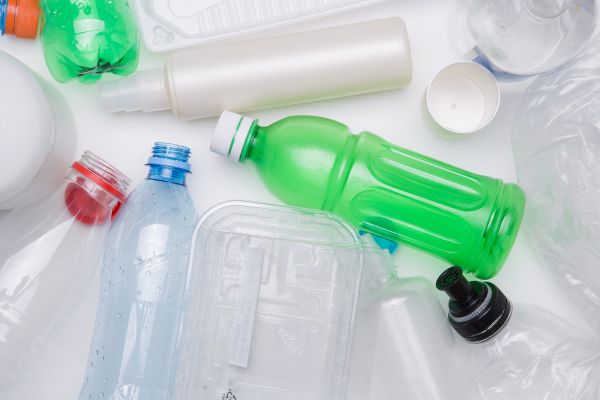
What are the characteristics of PET bottle production?
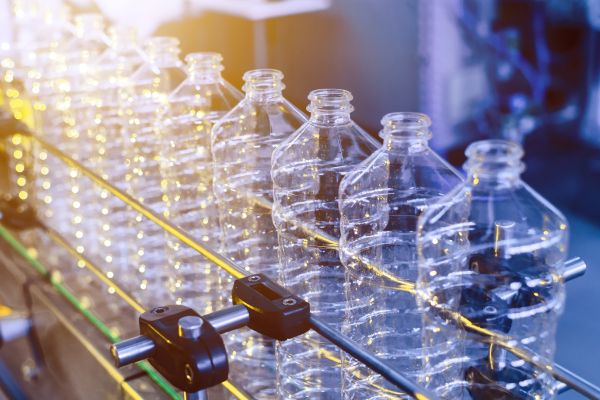
A semi-finished product preform is used to produce PET bottles. PET preforms come in a variety of kinds, colors, and variations. Some factors defining PET preforms are length, wall thickness, weight, and thread type. These characteristics will determine the blowing capacity of the preform bottles.
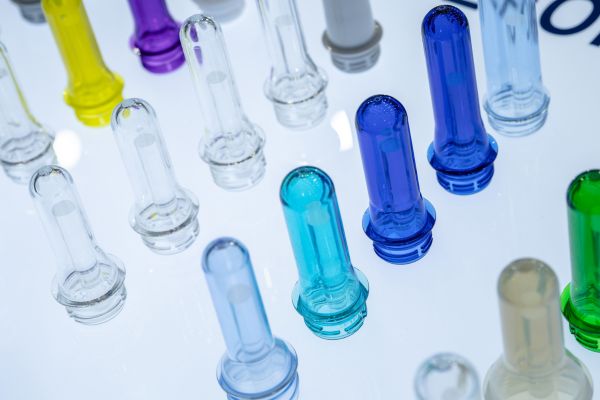
Blow molding usually uses a bidirectional stretching method, which means stretching vertically and horizontally. By being extended, oriented, and arranged in two directions, the mechanical qualities of the bottle wall and its tensile, impact, strength, and air tightness are improved. The initial sizes of the preforms are determined based on the dimensions and characteristics of the fully-formed bottles. The stretch-to-blow ratio also needs to be regulated carefully to avoid overstretching. The preform’s wall thickness varies depending on the bottles’ diameters, but it should not exceed 4.3 mm.
Bottle blowing often occurs between the glass transition and crystallization temperature, typically maintained from 90°C to 110°C. Overall temperature must be managed strictly during the blowing process. Besides, the stretching time, speed, pressure, and airflow must be set carefully before blowing.
What is the blowing process of PET bottles?
Currently, there are two methods of blowing PET bottles, which are single-stage and two-stage blow molding.
Single-stage blow molding
This method contains the preform creating, stretching, and blowing process in the same machine before cooling.
Process:
- Plastic resins are melted and injected into a preform mold.
- The preforms are then quickly cooled to the appropriate temperature for blowing.
- The preforms are reheated and inserted into the mold.
- After becoming softened, they are stretched vertically.
- Hot air is blown into the preforms, making them expand into the desired bottle shape.
- After cooling down, the mold is opened, and the final bottles are taken out.
Advantages and disadvantages:
The outstanding advantage of one-stage blow molding is the reduced handling because there is no need to transfer the preforms to another machine. Besides, as all steps are done in one machine, it will require less space. However, the cycle time may be lower, leading to lower speed and productivity.
The machine is often more complicated and costs more to install. Therefore, it is more suitable for producing small quantity production, which needs precise control of every product. Additionally, after making preform from resins, if the resting time is not enough, the structure will not be stable for the blowing process. It is also the reason why one-stage blow molding is rarely used today.
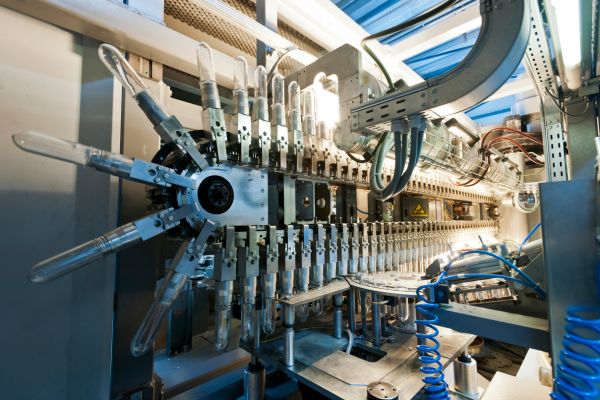
Two-stage blow molding
Two-stage blow molding involves using two machines, which are preform producing and blow molding equipment.
Process:
- Firstly, the preforms are made in an injection molding machine, typically in large quantities.
- They are completely cooled and stored or transported to the blow molding machine.
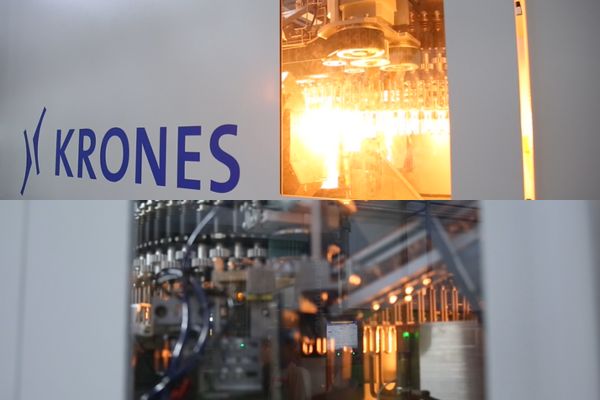
- After being transferred to the second machine, preforms are reheated to become softened. The temperature must be uniform to provide even blowing and constant wall thickness of the finished bottles.
- The preforms are introduced into the mold and closing unit.
- The softened preforms are mechanically stretched. Then, blow the compressed air and let the preforms expand against the mold walls, forming the bottle shape.
- The bottle is quickly cooled to harden the PET.
- After the bottles are formed, open the mold and discharge them.
Advantages and disadvantages:
The two-stage method is often used for mass production thanks to its higher productivity, lower equipment cost, and flexibility. By dividing the operations, each machine can operate concurrently, increasing productivity. In addition, this method is more flexible as the preforms can be stored for later uses or sold to a third party. Therefore, manufacturers can import preforms and only need to invest in blowing machines, which is more cost-effective. Instead, some costs, like energy costs for reheating preforms or transportation costs of semi-finished products, may be higher when compared to single-stage blow molding.
Compare PET bottles, Cans, and Paper Boxes:
PET bottles, CAN, paper cartons: Which beverage packaging is the best?
About Future Generation Co.,Ltd
Future Generation Company Limited is one of the largest beverage suppliers in Vietnam, with 29 years of experience in production and export. FGC is equipped with modern machines such as Hotfill PET and TetraPak, ensuring high-capacity production. FGC strives to achieve our mission to become Vietnam’s leading healthy beverage company. Our factories also meet international standards such as ISO, HACCP, etc. In addition, we constantly innovate our machinery system, strengthen production capacity, and increase productivity.
FGC also provides Private Label Services. With this service, we can help customers in researching and formulating beverages, designing product label packaging, and creating their own brands. This is an ideal solution for small and medium enterprises. Moreover, FGC provides free samples for customers to test before bulk orders. We also ensure delivery as fast as possible.
Contact
Address: R4 building, Office Quarter 02, Royal City, 72A Nguyen Trai St., Thanh Xuan Dist., Hanoi.
Phone: +84 24 73 000 125/ +84 24 73 063 369
Mail: info@vietnam-tea.com
Website: https://oem-fgc.com/
Facebook: https://www.facebook.com/fgcvietnamtea